Baringo County to enhance the capacity of women in digital, innovation and tech spaces

Women and girls in Baringo County will be empowered to embrace innovation and adapt to technological changes, a move that seeks to bridge the gender digital divide in the county. 

Speaking during the Baringo County celebrations of 2023 International Women’s Day themed ” DigitAll: Innovation and technology for gender equality” at Kabarnet National Museum grounds, Baringo County Governor, H.E. Benjamin Cheboi noted that his administration is committed to advancing gender equality by allocating more spaces and opportunities for women in the County. 

He said that despite the progress made in bridging the gender digital divide, statics still show that most women who are involved in entrepreneurship, agriculture and cultural spaces still do not know how to use digital platforms to market their products and services to reach their consumer base at the local, national, regional and global levels.

He pledged that his government shall empower women and girls to embrace new innovations and technological changes. “Baringo County government is committed to empowering women and girls to embrace innovation and adapt to technological changes so that we can achieve digital gender equality,” he said.

Further, he called on administrators to ensure that the capacity of women and girls is enhanced when it comes to procurement and tender opportunities at the county or national level. 

“We have put measures in place to ensure that women entrepreneurs are supported by the county government. I have directed various directors to ensure that the procurement department builds the capacity of women on how to apply for procurement and tender opportunities at the county government,” said the Governor.

The Governor also said the county government will work together with the Vocational Training Colleges to improve digital literacy among women and girls.

In Kwale County, Kwale County Governor, H.E Fatuma Achani encouraged women to apply for tenders at the county level. She also promised to support the success of the County SGBV Bill. 

In Busia, CECM Finance, Economic Planning and ICT, Mrs Topsister Wanyama affirmed the county’s commitment to prioritizing programs on innovation and technology by supporting the young women innovators. “The county is keen on integrating technology in its operations, therefore, there will be a lot of opportunities for young women innovators.

Collaborative Centre for Gender and Development supported this year’s IWD celebrations in Nairobi, Kwale, Busia and Kajiado counties. This year’s theme underscored the need for a gender-responsive approach toward innovation, technology and digital space.

By Carol Jebet, Vicky Kisilu and Sharon Ngaira
Confronting Sextortion

The expose by BBC on ‘Sex for Work; The True Cost of Our Tea BBC Africa Eye Documentary’ revealed the silent yet normalized gender-specific form of corruption that uses sex as currency, that is, sexual extortion.  Sextortion mainly affects vulnerable girls and women who seek various services such as National Identity Cards, supplies of sanitary pads, education, training and job placements, and promotions at workplaces.  Speaking during a Twitter Space live session dubbed ‘Sexual extortion as a gender-specific form of corruption in Kenya’ Jaqueline Mutere, the Co-founder of Grace Agenda, compared sextortion to rape: “The definition of Rape is anything that is not consensual and as long as I have not given you my consent willingly, that means you have extorted it or taken it by some form of coercion,” she said.

Further, she noted that due to the vulnerability of women and girls, sex has become very transactional and acts as a form of currency, citing sex for fish that is very rampant along the coastlines and shores where fishmongers give in so that they can attain the first pick from the boat.

“They were coerced to work there because they had no place to go because they were accommodated there and for you be accommodated and for you to work there and for you to get some refuge, you had to succumb to sexual favours,” said Ms Mutere.

On the other hand, Elijah Rottok, Senior Human Rights Officer at Kenya National Commission on Human Rights noted that our laws are still silent on linking gender and corruption to the extent that such incidents may be looked at as sexual abuse and just basic exploitation.

He said there is a need for state and non-state actors to distinguish sextortion from other forms of sexual and gender-based violence or sexual harassment.

“For sexual extortion, there has to be that abuse of authority and then the elements of exchange that I am giving you this for you to have this or for me to access this service. Sextortion is more about psychological coercion. So, there isn’t physical coercion when it comes to sexual extortion” said Rottok.

He added that sextortion may not necessarily imply that there is intercourse in some incidences, but it may cover cases where someone wants another party to either expose their body or send them an explicit image where they are exposing parts of their bodies.

Mr Rottok pointed out that cases of sextortion are prevalent within slums, especially around access to water where children who go to fetch water are exploited by the water vendors who ask for sexual favours so that they can skip the cues or even fail to pay.

Blandina Bobson, Programmes Director at Oxfam said people have normalized sexual harassment and the normalization has gotten to a point where people don’t think it is a big deal for people to be abused or sexually violated in order to access services.

She further said that often people become victims of sexual extortion due to their vulnerability which is well-known by the people who hold power.

“When a woman or man is put in a situation where you have to choose between providing for your family or getting a job, most people are driven to the world and do it not because they wanted, but because these people who hold power recognize the vulnerability in them and take advantage of it,” she said.

She said most of the victims of sexual extortion are not aware of their rights at workplaces or even educational institutions thus many cases are not reported.

“When you go to report, nobody will believe you – most people don’t even know their rights at the workplaces or even educational institutions,” said Blandina.

The discussions from the Twitter Space session point out that there is a clear and relatively less emphasis on the need to criminalize sextortion as a form of corruption because it is normalized. This normalization has, and continues to negatively affect vulnerable groups such as youth and women considering that sex is used as the currency in exchange for services, they may be seeking for

 There is a need to amend anti-corruption laws to include sextortion as a form of corruption to stop the normalization and persistence of the practice.

To achieve this, and with support from Ford Foundation, Collaborative Centre for Gender and Development has partnered with Kenya Human Rights Commission to conduct a study to understand how and where sextortion occurs, its incidence and how it may be presented as the form of corruption to aid efforts to reduce and eventually stop it. . This study will contribute evidence for policymakers to draft a robust inclusive multisectoral anti-corruption policy and implementation mechanism that shall comprehensively recognize and address the issue of sextortion as a form of corruption.

By Diana Mwanzia and Maurice Goga

Quenching community thirst through Jasiri Fund

Upon our arrival at Mrs Zan Rashid Zan’s homestead, we meet with several women with water jerricans on their heads, a sign that her homestead is a fount of the basic commodity that the community depends on.
Mrs Zan Rashid Zan is a renowned water vendor in Matuga sub-county, Kwale County. She has been in the water business for the past 10 years quenching the thirst of her community.

Despite being in the business for 10 years, she has not been able to serve the community fully since she did not have a proper water reservoir to reserve enough water for the community. However, things took a new turn when she learned about the existence of the Jasiri Fund.

“I learned about Jasiri Fund through a friend who informed me that there is an organization called Collaborative Centre for Gender Development (CCGD) which was equipping women survivors of SGBV with entrepreneurship skills and linking them with loans from Kenya Women Finance Trust Bank,” said Zan Rashid.

Later, she was enrolled as a beneficiary of the fund where she took a loan of Ksh.150, 000 which she used part of the money in purchasing a 5000 litres water tank which is acting as a water reservoir.

“I got Ksh.150,000 as a loan from Jasiri Fund and used part of the money to purchase a new water tank to replace the old tank. I also used the money to buy more cattle,” she said.

She says the water business is profitable since she can make up to Ksh.3,000 within a week, where a 10-litre jerrican goes for 5/= while a 20-litre jerrican goes for Ksh. 10/= thus enabling her to service the loan and fend for her family.

For Zan Rashid, her main dream is to have a borehole where she can have a constant flow of water as opposed to having the tap one which she says often breaks thereby affecting her business.

Apart from the constant breakdown of tap water, her business also faces competition from other water vendors within Matuga, whom she says has a borehole and freshwater as opposed to her water which is not as fresh as her competitors.

Mrs Rashid has also ventured into livestock rearing and hopes to expand when she gets her next loan. She attributes the new venture to the frequent entrepreneurship training by CCGD that has helped her learn more about financial management and record keeping.

“I am a beneficiary of Jasiri training before I used to run the business and I couldn’t manage my financial records perfectly. But after attending several pieces of training, I can now manage my finances well – I know the amount to spend, pay water bills and service my loan,” she explained.

Her call to CCGD is to make Jasiri Fund reliable and affordable to several women in Kwale County.

With support from Mastercard Foundation, through the Response, Recovery and Resilience Project in partnership with CREAW and GROOTS Kenya, CCGD has facilitated affordable financial services to women such as Mrs Zan Rashid Zan through Jasiri Fund. CCGD is currently implementing the program in Kwale, Kajiado and Busia Counties. As of December 2022, 278 women and youth (young women) and Persons with Disabilities (PWDs) with existing businesses had received loans worth Ksh. 15, 115, 875.

By Maurice Goga

Profits from the Jasiri Fund loan brought relief in my life

Covid -19 nearly brought to halt business operations not only in Kenya but globally. This follows the stiff measures that were placed to curb the spread of the virus, these measures affected women’s labour markets. Businesses such as greengrocery, mitumba (second-hand) clothes, and fish mongering which are dominated by women were hard hit as compared to those operated by men. The situation was exacerbated by the spike in cases of gender-based violence witnessed during the stay-at-home period.

To re-energize and rebuild the resilience of women survivors of SGBV, Mastercard Foundation supported a consortium of three organizations- CREAW, Groots Kenya and CCGD to develop Jasiri Fund. This non-collateral loan sought to facilitate affordable financial services s women survivors of sexual and gender-based violence (SGBV) in Kenya in the wake of Covid-19.

To date, over 700 women have benefitted from the program. One of them is Ms Dolrose Awino, a greengrocery businesswoman based at Kinango market in Kwale County. Despite having a successful business before the onset of Covid-19, all the success she had made was watered down by the pandemic. Her situation was worsened by the continuous domestic violence she experienced in her marriage.

“My ex-husband used to beat me, he demanded that I leave the house by 10:00 am and come back by 5: 00 pm failure I would be battered. The man used to beat me daily because of the nature of my job where I have to leave early to the market and come back late in the night,” she narrated.

But when push came to shove, Ms Awino walked out of the abusive marriage. She was later enrolled as a beneficiary of the Jasiri Fund program where she was among other survivors who were taken through many entrepreneurship training before being given loans.

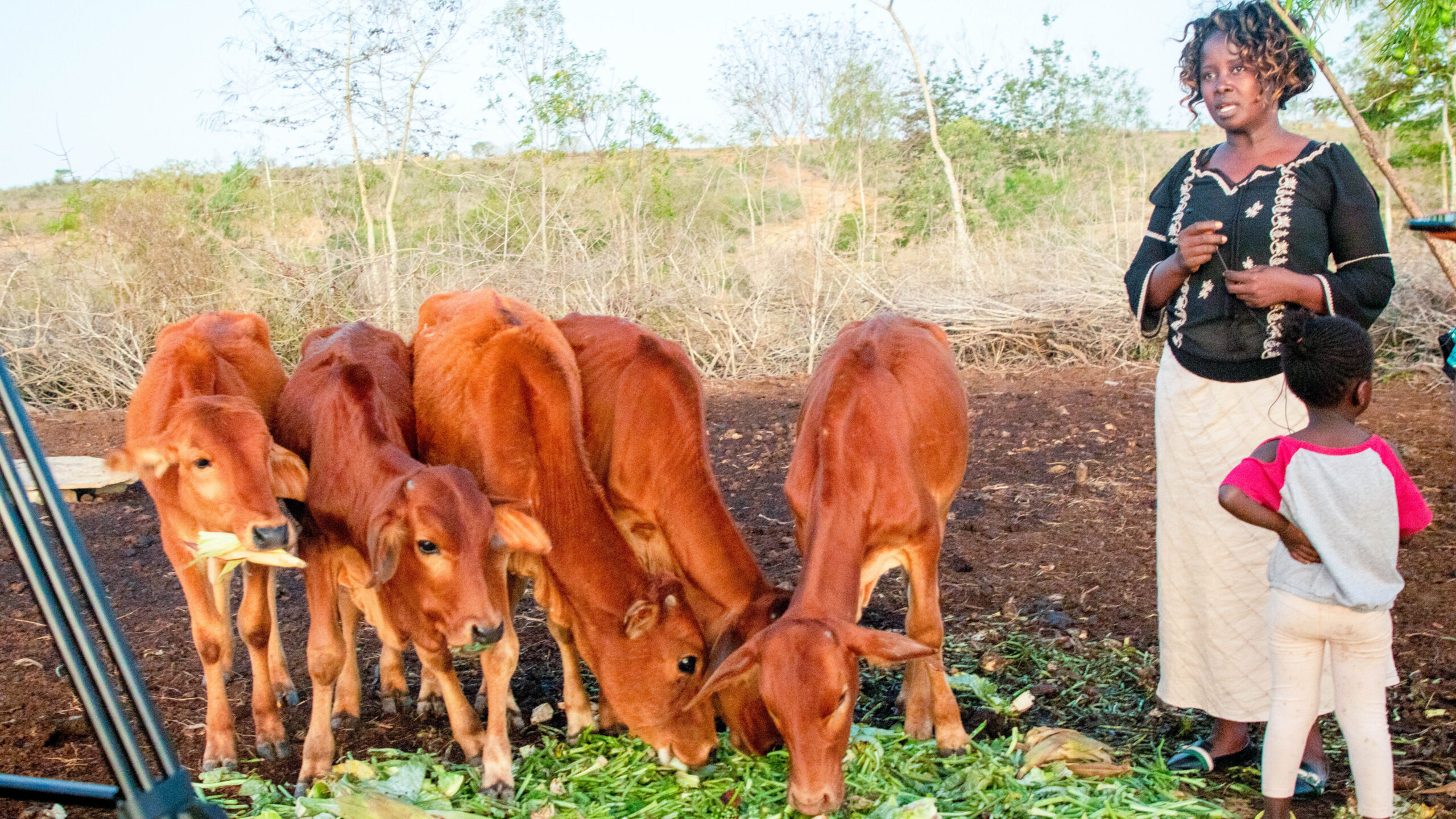
“Personally, I was given a loan worth Ksh, 80,000 which I used to boost my business and the profit ploughed from the business is what I used in buying these five cattle as I plan to venture into livestock keeping.,” she explained.

Added: “From the loan, I could use Ksh. 15,000 to buy a sack of sardines from Kisumu out of which I would make a profit of Ksh. 10,000 per sack and that is how I managed to raise money to buy these cattle.”

Ms Awino has not only ventured into cattle rearing but aspires to open up a retail shop within Kinango “As we speak, there is a place I have identified that am planning to open up a retail shop this is due to the harsh economic time we are facing. So, if I can combine the two businesses – greengrocery and shop then I will be one step ahead;” she said.

She remains buoyant that Jasiri will continue empowering more women like her. She, however, calls upon the program implementors to onboard more women in the program as this will help in reducing cases of SGBV in the county.

Despite making business progress, Ms Awino faces several challenges which she says has affected the business considering that her businesses rely heavily on Jasiri loan. “Some of the challenges we are facing here in Kinango are drought and rise in the price of commodities which have adversely affected our businesses,” said Ms Awino.

She pleaded with women in business to reduce expenses in their businesses and turn their focus into savings.

“I urge fellow women in business to put more effort into savings and avoid too many expenses in their businesses. They should also set targets in their businesses,” she said.

With support from Mastercard Foundation, through the Response, Recovery and Resilience Project in partnership with CREAW and GROOTS Kenya, CCGD has facilitated affordable financial services to women such as Ms Dolrose Awino through Jasiri Fund. CCGD is currently implementing the program in Kwale, Kajiado and Busia Counties.

By Maurice Goga

Role of young men and boys in ending FGM

The theme for the 2023 International Day for Zero Tolerance for FGM: ‘Partnering with men and boys to transform social and gender norms to end Female Genital Mutilation’ highlights the need for male engagement in lifting the voices of women and girls in the campaign to end FGM.

A 2020 study by the United Nations Population Fund-UNICEF Joint Programme on the Elimination of FGM found that 89 percent of boys and men and 92 percent of girls and women were opposed to FGM. Meaning for FGM to end, there is a need for actors to address social norms that perpetuate the practice of FGM with a key focus on the active involvement of men and boys as partners in ending FGM.

In line with the 2023 theme, Collaborative Centre for Gender and Development (CCGD) organized a Twitter Space on what role young men and boys play in the eradication of FGM in Kenya on Thursday, February 16, 203.

Speaking during the space, Baringo County Youth Senator, Kalu Lepariyo noted that the fact that the African setting is a patriarchal setting in nature disadvantages the women and girls since men play a pivotal role in cultural issues since they are the custodians of those cultural structures, beliefs and systems. 

“Women have been disadvantaged and subjected to FGM and other cultural practices since they don’t have much say when it comes to cultural issues,” he said.

He added that the conversations around FGM have been a women’s affair for the longest time and men have been on the bench when it comes to such conversations. He, however, lauded the change that has been witnessed in the recent campaigns to end FGM where a number of young men have joined the campaign to end FGM in Kenya.

“It is now encouraging to see young men like my brother Leshan coming out clearly to challenge the government and other key stakeholders to take action against FGM. Others have even called for their involvement in advocacy against FGM,” he said.

The SDG5 champion called for the empowerment and education of women and girls as the way to emancipate them from the bondage of FGM and other harmful cultural practices.

On his part, the Chairperson of the UNFPA Youth Advisory Panel, Mr. Leshan Kereto noted women and girls often become vulnerable to FGM and other harmful cultural practices during conflicts and disasters such as drought.

“When drought strikes, young girls have to be given out for marriage to get back the cattle that have died. For this to happen, the girls have to be prepared for marriage through FGM,” he said.

The  Executive Director of Malkia Initiative, Ms, Jedidah Lemaron said that involving men in the fight against FGM is very critical as they will play a role in advancing and promoting gender equality and empowerment of women.

Adding that the majority of girls from the FGM-practicing community are subjected to the cut because of the fear of not getting married as men from those communities usually fear marrying uncut women as a result of stigmatization from the community.

“We have been socialized to believe that if you are ‘uncut’ you will not get married, the fear of not getting married is what is pushing women and girls to undergo the cut,” noted Lemaron.

She called on the members of the community to work together to end FGM saying that men supporting women will create an environment where everyone’s voice will count especially in decision-making in matters affecting the community.

Lack of political goodwill from the local leaders for fear of losing votes during the general elections, cross-border FGM and the medicalization of FGM were also cited as some of the trends that still fuel FGM in Kenya.

More needs to be done toward the eradication of FGM in Kenya

The youth have called on the various stakeholders in the campaign against FGM to fasten their belts if the country is to witness zero FGM by 2030

Speaking during the Twitter Space, Leshan Kereto, the Chairperson UNFPA Youth Advisory Panel noted despite Kenya’s lead towards ending FGM in Africa, there are many things that the country desire to do if the vice is to be eliminated by 2030.

Adding that a 6% reduction in the prevalence of FGM from 21 percent in 2014 to 15 percent in 2022 requires the stakeholders to fasten their belts if the country is to witness zero FGM by 2030.

He noted that there is a need for the country to improve on economic investment in ending FGM  to enable the country to end FGM by 2030.

“We are not having enough funding globally, the resources that are needed to prevent a girl from undergoing FGM is 9 dollars per girl and what we have is not even close to that,” said Leshan.

The Anti-FGM award winner called on the government to increase funding to the Anti-FGM Board and fund the community-based organizations fighting FGM at the grassroots level.

“As a country, the economic component should come out very well – let’s support CBOs to continue supporting girl child education because we all know that education is the only way we can run away from harmful cultural practices,” he said.

On her part, Jedidah Lemaron, Executive Director at Malkia Initiative attributed the reduction of FGM in Kenya to the robust anti-FGM campaigns that have been carried out by different actors including the youth who have come on board to campaign against vice in their respective counties.

She added that the existence of legal and policy frameworks against FGM also contributed to the reduction of the prevalence of FGM in the country.

“Existence of legal and policy frameworks such as the Prohibition of Female Genital Mutilation Act, 2011, the National Eradication of FGM Policy and the county-based policies such as the anti-FGM policy by Kajiado County are some of the key strides that led to the reduction of FGM in Kenya,” said Jedidah.

She, however, called upon the KNBS to release the county-specific data on FGM saying communities have become tactful when it comes to the practice of FGM as a way to circumvent the law.

“It will be interesting to see the numbers because of emerging trends in FGM – where communities have developed new strategies of practicing FGM,” she said.

Ms. Lemaron called for resourcing of grassroots organizations more specifically those ran by the youth who are at the frontline of the campaign against FGM. She cited the Kuria youth who came out strongly to oppose the practice of FGM during the last December holiday.

“I am sure if we can resource the young people with knowledge and finance, we will be able to make more strides in the campaigns to end FGM,” said the Anti-FGM Activist.

She urged the policy maker and implementors to return to the drawing board and rethink of strategies for ending FGM. “As a country, we should go back to the drawing board and rethink of even how we are packaging our anti-FGM messages,” she said.

By Maurice Goga

TeenSeed Africa Seeks Partnerships to Enhance Support to Survivors of SGBV

TeenSeed Africa is a local community-based organization based in Kayole and Kiambiu area of Nairobi County. The Executive Director TeenSeed Africa, Ms. Winnie Obure says TeenSeed Africa’s main program’s focus is on survivors of SGBV – women and teens. Further, they also work around the prevention of teenage pregnancies through Sexual and Reproductive Health Rights […]

Jasiri Fund boosted my business after the COVID-19 pandemic

The COVID-19 pandemic disrupted business operations in Kenya as in other parts of the world.

For Ms. Josphine Jerop, a hotelier in Kinango sub-county, Kwale County her hotel business was shut down. The profit she had made before the shutdown is what she survived on until the normal return. Upon resuming after covid restrictions were lifted there were still fears of contracting the disease through places of gathering such as hotels thus making it hard for her to make a profit.

 Ms. Jerop hopes were revived after she learned about the existence of Jasiri Fund: a microfinance project through a friend.

After being listed as the beneficiary of the Jasiri Fund, Ms. Jerop was able to acquire a loan of Ksh. 300, 000 which she used to boost her business by renovating the hotel, buying kitchen wares and more seats.

“I shared my proposal on how I intend to use the loan and luckily enough I was able to get a loan of Ksh. 300, 000 which I used in doing some renovations at the hotel and purchased more kitchen wares.

After acquiring the loan, she has noticed a big change in her business and hopes to build a guest house where her customers can get somewhere to rest after taking their meals.

“I am looking forward to building a guest house here because many of my customers usually ask for a place to spend their night. I hope when I acquire my next loan I will build the guest houses,” she said.

Ms. Jerop calls on other women in business to embrace the art of acquiring and paying loans if they want to be successful in their businesses. She further lauds the stakeholders in Jasiri Fund for coming to the aid of many women like her by creating an affordable and accessible financial service.

“When you look at Jasiri Fund, it is not similar to other loans – this loan does not require collateral and the interest is quite low. Basically, it suits us women in business,” explained Jerop. With support from Mastercard Foundation,  CCGD has facilitated affordable financial services to women such as Ms. Josphine Jerop through Jasiri Fund. CCGD is currently implementing the program in Kwale, Kajiado and Busia Counties. As of December 2022, a total of 278 women and youth (young women) and Persons with Disabilities (PWDs) with existing businesses had received loans worth Ksh. 15, 115, 875. CCGD partners with CREAW and GROOTS Kenya who implement the project in 6 other counties

Namanga Childcare Centre Set to Open

The establishment of Namanga childcare centre in Namanga town is steps away after the Kajiado County Government and Collaborative Centre for Gender and Development (CCGD) signed a memorandum of understanding (MOU) at county government offices in Kajiado town on Tuesday, December 6, 2022.

The County Government shall secure the location of the facility and provide staff  

 CCGD shall facilitate the quality delivery of childcare services by building the capacity of the caregivers and parents association and management committee.  CCGD shall also contribute to the cost of running of the facility as well as collecting, analyzing and disseminating data to inform policies.  

Speaking during the signing of the MOU, the County Secretary, Mr Francis Ole Sakuda, welcomed the partnership saying the county government will accord CCGD and other partners all the support they may need with regard to child protection.

Adding that the county government was fully aware of the disproportionate burden of childcare duties performed by women and had provided space in the Ngong Market for the establishment of a childcare facility.

On his part, CCGD Executive Director, Mr. Masheti Masinjila said ongoing discussions with Namanga women cross-border traders had resulted in the partnership to between Kajiado County and CCGD to address childcare challenges.

The signed MOU agreement seeks to increase women traders and other working women’s access to childcare facilities and enable them to concentrate on their work and increase their productivity.  The partnership should also inform Kajiado County on what it takes to provide childcare to enable them to make appropriate budgetary allocations.

Present at the signing of the MOU ceremony was County Executive Committee Member for Public and Social Services, Mr. Alais Kisota; County Chief Officer, Ms Rose Mumbe; Director of Social Services, Ms. Irene Katete; Deputy Director Social Services Mr Philip Murre; Coordinator Social Protection, Agnes Payiaton and a team from CCGD which included, Program Officer Childcare and Child Protection, Ms. Grace Kathau; Human Rights Officer, Ms Diana Mwanzia, Communication Officer, Maurice Goga and Kajiado County Administrator, Ms. Ruth Nashipae.